You know the scenario: the middle of summer, it's scorching hot, and a driver pulls into the depot and reports that the air conditioning in the cabin is barely working. You connect the station, but there's no refrigerant. You refill the system, the truck goes on the road, and two weeks later, the problem returns. Leaks in truck A/C systems can keep even the best mechanics awake at night.
Air conditioning leaks can keep even the best mechanics awake at night.
Air conditioning systems aren't overly complex, but the lines running from the compressor at the engine to the evaporator (or evaporators) are often difficult to access, making them difficult to diagnose. They're constantly exposed to extreme vibrations, extreme temperature changes, and aggressive road chemicals. The slightest crack in a connector or abrasion in a hose under the cabin causes a slow, troublesome leak of refrigerant. Evaporator failure is also a challenge for a mechanic, because how can you inspect something... mounted in the dashboard from all sides?
Below are some methods you can use in the workshop to avoid looking for a needle in a haystack.
In the daily work of a truck service, there's no single perfect method, but combining them yields the best results. A quick inspection with a UV lamp allows you to immediately rule out major mechanical damage to the front of the vehicle. If that doesn't help, a trace gas (hydrogen) test will pinpoint even the most difficult-to-detect defects buried deep within.
in the lines or evaporator. Investing in a trace gas kit is an expense that quickly pays for itself in the summer season in saved mechanic time and – most importantly – in the absence of complaints from irritated drivers.
This is the most popular method on most websites. You introduce a special contrast to the layout, put on yellow glasses, grab a UV flashlight, and look for bright green spots under ultraviolet light.
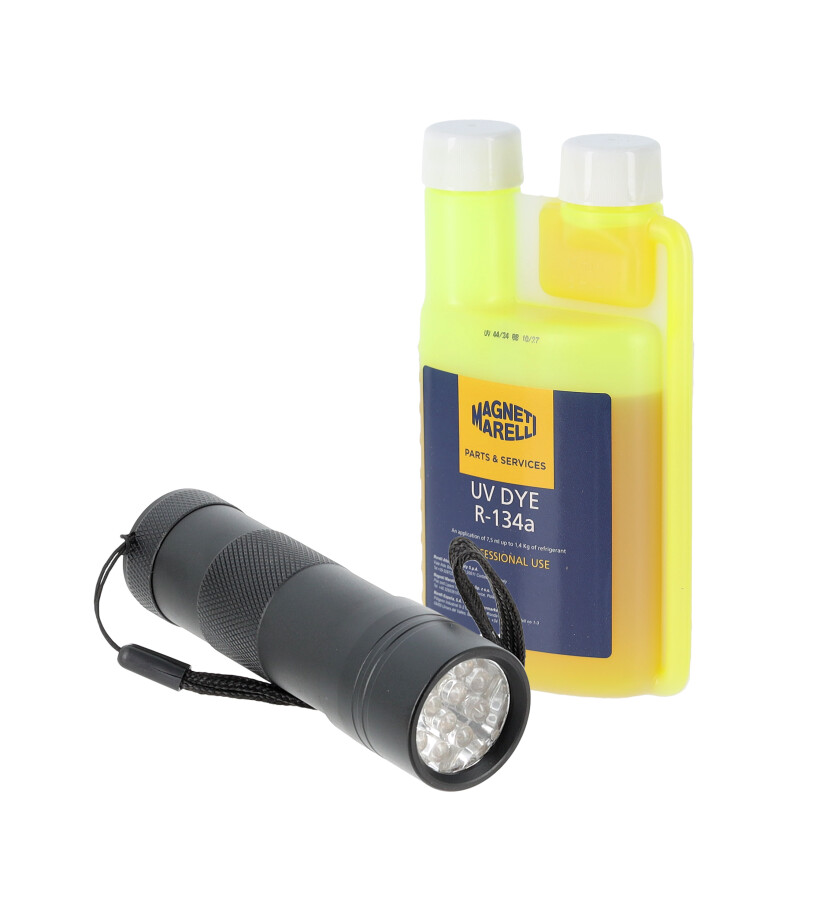 UV CONTRAST FOR AIR CONDITIONING LEAKS (A:0876630)
UV LAMP (A:0301948)
Advantages:
Defects:
A device that detects refrigerant particles in the air. You hold the probe close to the suspected area, and when the device "smells" the leaking gas, it starts beeping loudly.
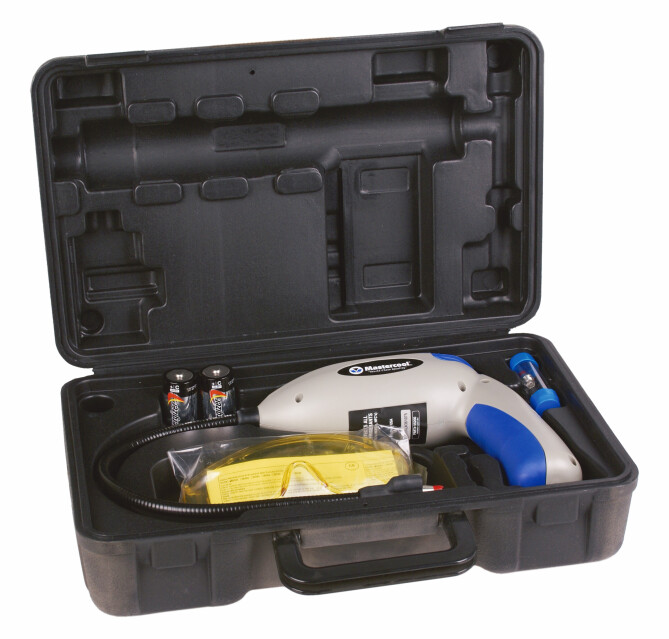 ELECTRONIC LEAK DETECTOR WITH UV LAMP (A:0097817)
Advantages:
Defects:
Therefore, with this method, it is recommended to clean and dry the elements being diagnosed, because the sensors used in the "sniffers" and semiconductor sensors (MOS) may react to volatile organic compounds contained in alcohol (windshield/washer fluids), glycol, brake cleaners and hot engine oil vapors.
Currently, it's the most effective and professional weapon in a modern workshop. Pressurized nitrogen, or even better, a special gas mixture (95% nitrogen and 5% hydrogen), is injected into a completely evacuated system and the pressure drop is monitored over time. Why is hydrogen the best choice? Because it has the smallest molecules of all elements. This means it can squeeze through absolutely any crevice, even the smallest. A dedicated electronic hydrogen detector is used to pinpoint the leak.
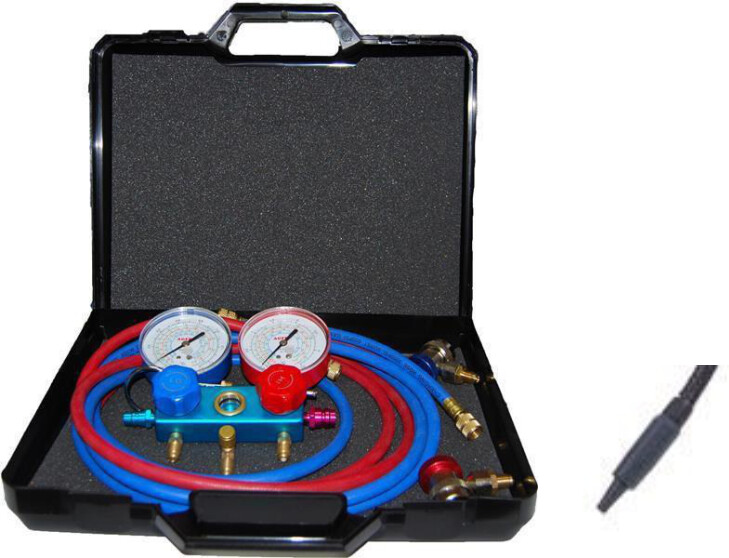 SET OF MANOMETERS AND HOSES FOR AIR CONDITIONING TESTING WITH NITROGEN MAGNETI MARELLI (A:0148890)
SENSOR FOR ELECTRONIC LEAK DETECTOR HYDROGEN MAGNETI MARELLI (A:0446980)
Advantages:
Defects: